
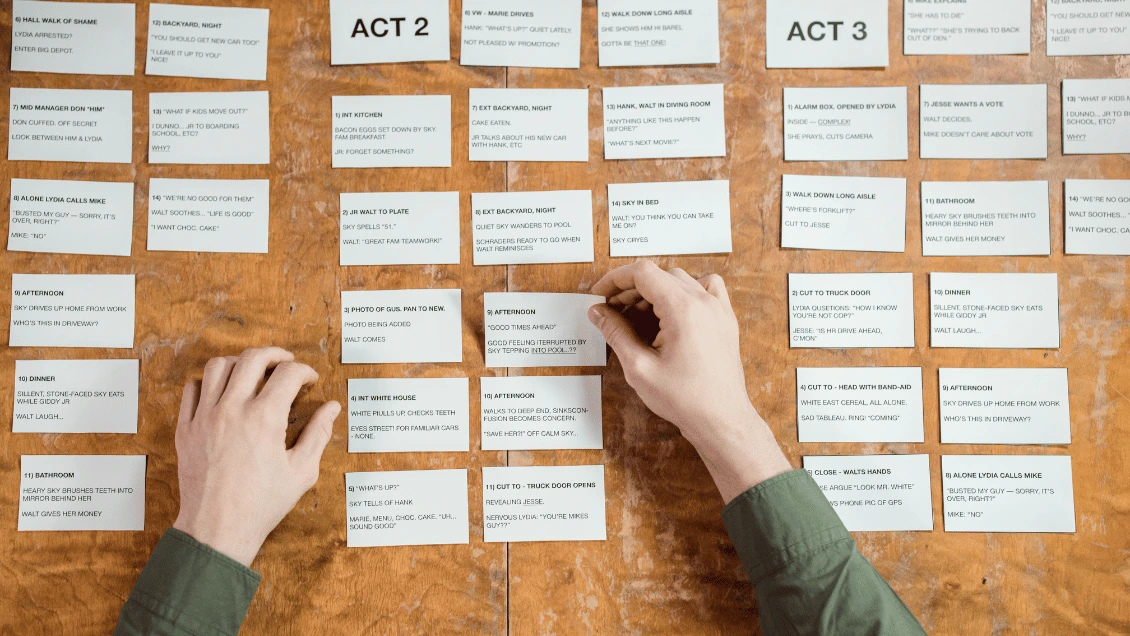

You wouldn't build a house without blueprints. So why draft 80,000 words without a map? Learning how to storyboard a novel is one of the most powerful things a writer can do before typing Chapter One. Storyboarding is a visual plotting method. borrowed from filmmaking. It lets you lay out your entire narrative as a series of connected beats, scenes, or story moments on a single canvas. Instead of holding your whole plot in your head (or buried in an outline document you'll never re-read), a storyboard lets you see your story the way a director sees a film.
What Is a Novel Storyboard, Really?
A storyboard is more than a chapter list. It's a visual map of your plot. You can zoom out and ask: Does this story have a shape? You can spot pacing problems at a glance, identify scenes that do no narrative work, and catch structural issues before they cost you weeks of revision.
A storyboard can serve as a map of cause-and-effect. For example, your main character's social blunder in one scene might create tension that spawns a conflict in the next, and that conflict might lead to an outcome that makes reaching their goal harder in a subsequent scene. In a novel with many different subplots and arcs, you can immediately see how often you're checking in with them. When those relationships are visible, you can make smarter decisions faster.

How to Storyboard a Novel Using World Anvil's Whiteboards
World Anvil's Whiteboards feature is purpose-built for exactly this kind of visual planning. You can create cards or sticky notes for each scene, arrange them in sequence, color-code by subplot or POV character, and draw connecting lines to show cause-and-effect relationships between plot points. It's a flexible, infinite canvas — which means your story structure can sprawl, branch, or fold back on itself exactly as your narrative demands.
Here's a simple process to get started:
- Open a new Whiteboard in your World Anvil project and title it with your story's working title.
- Create one card per scene (or per chapter, if you're outlining at a higher level). Include a one-sentence summary of what happens and what changes as a result.
- Arrange the cards in sequence from left to right, or top to bottom — whatever feels intuitive.
- Color-code by function: use one color for inciting incidents and turning points, another for subplots, another for character development beats.
- Draw connector lines between cards that are causally linked. This is where the magic happens — you'll immediately see if your narrative flow has gaps or dead ends.
- Step back and read the shape. A healthy three-act story should have a visible rise-fall-rise pattern. A midpoint shift should be obvious. If everything looks flat, you know where to dig.
The ability to move cards around freely — without the friction of rewriting a linear outline — makes it far easier to experiment with structural changes before committing to the draft.
Common Story Structures to Storyboard
One of the great advantages of storyboarding is that it works with any story structure. Here are some of the most widely used frameworks writers apply when learning how to storyboard a novel:
- The 3-Act Structure — The foundational framework: Setup, Confrontation, Resolution. Every scene should serve one of these three phases.
- Save the Cat Beat Sheet (Blake Snyder) — A 15-beat structure including the Opening Image, Catalyst, Break into Two, Midpoint, Dark Night of the Soul, and Final Image. Each beat is a natural storyboard card.
- Dan Wells' 7-Point Story Structure — Built around Hook, Plot Turn 1, Pinch 1, Midpoint, Pinch 2, Plot Turn 2, and Resolution. Excellent for genre fiction writers who want a tight, tension-driven frame.
- The Snowflake Method (Randy Ingermanson) — A developmental approach that expands outward from a single sentence to a full scene list. Works beautifully alongside a Whiteboard as your scene list grows.
- The Hero's Journey (Joseph Campbell / Christopher Vogler) — A 12-stage mythic structure mapping a protagonist's transformation. Especially useful for fantasy and adventure narratives.
Each of these maps cleanly onto a World Anvil Whiteboard — simply use the structure's beats as your card categories or column headers.
Fix Your Structure Before You Draft
The biggest gift a storyboard gives you is permission to fail fast. Moving a card on a whiteboard takes two seconds. Restructuring three acts in a completed draft takes months. When you know how to storyboard a novel, you catch the problems while they're still cheap to fix: the subplot that never pays off, the midpoint that arrives too early, the antagonist who disappears for fifty pages.
Your story has a shape. Storyboarding is how you find it — and fix it — before the real writing begins.
If you'd like to join a whole community of natural-born storytellers, create your free World Anvil account today. With monthly challenges, a whole set of writing and worldbuilding tools, and the friendliest community on the internet, it's a great place to get inspired to power through your next novel.